From Dialogue to Practical Business Solutions: Highlights From the Conference “Organic Day in Ukraine”
What has to be changed so that the organic sector in Ukraine can grow and producers can make full use of the opportunities offered by domestic and international markets?This very question was one of the key topics in the panel discussions during the conference “Organic Day in Ukraine” which took place on 23 September in Kyiv and online.
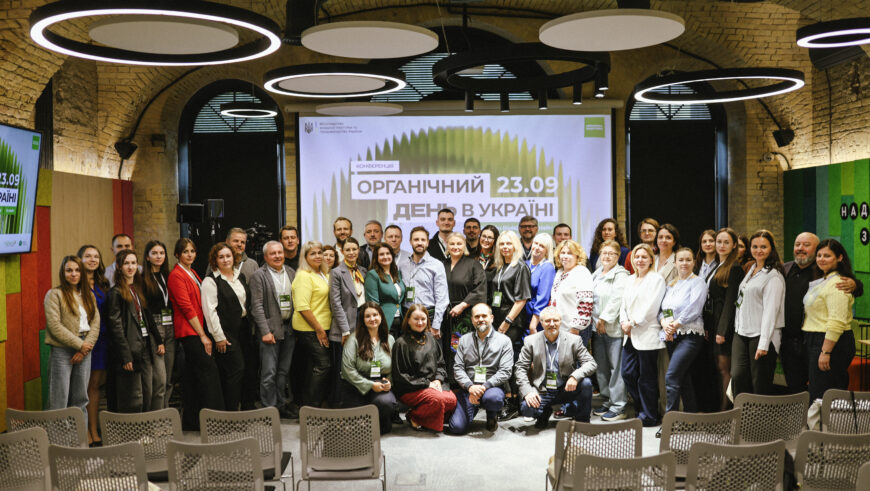
Organic Initiative Public Association, with support of Switzerland and Germany, brought together representatives from the government and business, international partners, organic companies, and the expert and educational communities under one roof. During the event, the participants did not only discuss the challenges the sector is facing today, but also the rules, decisions and tools it will need in the future.
The discussion focused on the government policy and business support, European integration, new requirements for organic production, domestic market development, exports, access to finance, and companies’ resilience in times of uncertainty.
Taras Vysotskyi, Minister of Agrarian Policy and Food of Ukraine, opened the conference with a welcoming speech:
“Despite the challenges of a full-scale war, Ukraine’s organic sector retains its potential for growth. Today, more than 450 operators are certified in accordance with the EU and/or US organic legislations while over 300 are listed in the state register of operators operating in accordance with Ukrainian organic legislation. Ukraine also remains among the top five suppliers of organic products to the EU. This shows that Ukrainian producers are continuing to operate and invest in development. At the same time, it is important to continue supporting the sector, fostering a favourable regulatory environment and strengthening cooperation between the government and the business community. I am grateful to Ukrainian producers, certification bodies, international partners, in particular Switzerland and Germany, and everyone who is working with us to develop organic production in Ukraine,” saidTaras Vysotskyi, Minister of Agrarian Policy and Food of Ukraine.
Alyona Lashko, Senior Expert for the Organic Component of the Swiss-Ukrainian Programme “Higher Value Added Trade from the Organic and Dairy Sector in Ukraine” (QFTP), addressed the participants with a welcome speech, noting that:
“Switzerland has been supporting the development of the Ukrainian organic sector for over 20 years, and today this partnership continues within the framework of the QFTP programme. We provide comprehensive support to the sector — from improving legislation and capacity development of state institutions to developing services and supporting businesses. In the next phase of the programme we will focus particularly on the development of Ukrainian service providers in order to establish a sustainable support system for organic businesses which will contribute to the sector’s long-term development and its entry into the European and other international markets”.
The opening session concluded with a speech by Oleksandr Zhemoida, Deputy Project Manager and Project Expert for the German-Ukrainian Agricultural Policy Dialogue project (APD Ukraine).
“For us at APD Ukraine, supporting Ukraine’s organic sector is not a one-off event; it is part of a systematic effort towards the European integration of Ukrainian agriculture. In May this year, we supported the Field Forum in Poltava region, where producers and experts discussed practical solutions for organic production right in the field, and today we are continuing this dialogue at the level of policy, markets and future conditions for the sector development. Ukrainian organic producers are already well integrated into the European market, so the next task is not simply to adapt to the EU rules, but to use the accession process to strengthen their competitiveness, expand the domestic market, and create new opportunities for Ukrainian producers”.
Direct dialogue between the organic sector and the government
The practical part of the event began with a panel discussion “Dialogue Between the Organic Sector and the Ukrainian Public Authorities: Sector Challenges and State Policy” which focused on how government policy affects operations of organic businesses and what changes are needed for the sector development.
Together with Taras Vysotskyi, Minister of Agrarian Policy and Food of Ukraine, the directors and owners of organic enterprises discussed the Ministry’s priorities, the current needs of the sector, barriers faced by producers, and practical ways of overcoming them. The focus was on issues that directly affect production planning, investment decisions, processing expansion, and entry into new distribution channels and markets.
European integration: from adapting to the rules to new opportunities
A particular focus of the conference was European integration and its practical significance for business, which was discussed in detail during the second panel discussion “Organic Sector of Ukraine on the Path to the EU Membership”.
The EU market remains a key destination for Ukrainian exports. According to the study by Organic Standard, in 2025 the EU countries accounted for around 94% Ukraine’s organic exports. Consequently, the question for businesses is shifting from ‘how to enter this market?’ to ‘how to establish a foothold in it and compete for a larger share?’
The panellists analysed the EU policy on organic production, assessed new opportunities for the country and focused on the practical aspects of European integration processes. In particular, they focused on the alignment of the Ukrainian legislation with the EU requirements: new rules, operators’ responsibilities, as well as control and certification system. The experts addressed the key question: how these changes will affect companies’ day-to-day operations and whether the adaptation process could enhance the competitiveness of Ukrainian producers.
Johanna Stumpner, a representative of the Legal Affairs and International Relations Department of the Association of Organic Food Producers (AöL); Oleksandr Starynets, Head of the Secretariat of the Verkhovna Rada Committee on Agrarian and Land Policy; Perica Ivanoski, Senior Expert on Agricultural and Rural Development Policy at the EU-funded IPRSA III / EU4SmallFarms Project (NIRAS), Maryna Kyslytska, Head of the State Policy Division on Organic Production, Department of State Policy on Sanitary and Phytosanitary Measures and Food Safety, Ministry of Economy and Environment of Ukraine, and Kateryna Shor, member of the board at Organic Initiative Public Association and a representative of International Charitable Organisation “Green Dossier”, took part in the discussion.
The panel was moderated by Oleksandr Zhemoida, Deputy Project Manager and Project Expert for the German-Ukrainian Agricultural Policy Dialogue Project (APD Ukraine).
How do businesses operate in times of uncertainty?
The organic sector is currently operating despite the war, instability, logistical risks, labour and energy challenges, and the need to maintain production at the same time looking for new opportunities for growth.
The representatives of Ukraine’s leading organic companies shared their experience of overcoming the challenges of 2026 as well as practical solutions for operating in conditions of uncertainty during a separate panel discussion. They also emphasised the importance of preparing for the 2026–2027 autumn–winter season, a period which for Ukrainian businesses is traditionally associated with additional operational and energy risks.
Yuliia Voroschuk, Head of Organic Expert LLC, Yevhen Motsnyi, Commercial Director at Skvyrskyi Grain Processing Factory LLC, Dmytro Sharov, Director at Danube Agrarian Trade House, Oleksandr Ratushniuk, owner of Jiva LLC, as well as Olena Kukhtyuk, Head of HR and Legal Support Department at Organic Milk LLC, Organic Meat LLC and Home Chicken Farm took part in the discussion and shared their companies’ experience. The panel was moderated by Oleksandr Prykhodko, Market Development Expert.
Market and new opportunities for business development and support
The practical part of the conference continued with presentations by experts that focused on the market and new opportunities for the development and support of companies.
Yuliia Galashevska, Head of Export Department at Organic Standard LLC, explored the topic of foreign trade and new opportunities for local players. In her presentation, she outlined the latest statistics and structure of organic imports into Ukraine, as well as identified promising niches that Ukrainian operators can effectively develop on the domestic market.
Grant opportunities within the Grant Desk available to the members of Organic Initiative Public Association were also presented. Lyubov Ostapiuk, Expert in Grant Funding and Project Development, and Ksenia Shyshenok, Business Planning and Grant Acquisition Specialist, spoke about securing grant funding and project development.
In addition, the organisers presented organisational aspects of preparing the National Pavilion of Ukraine for BIOFACH 2027, as well as other opportunities for participation in international trade events.
Pavlo Ladetskyi,National Project Technical Coordinator at Global Quality and Standards Programme (GQSP Ukraine), United Nations Industrial Development Organisation (UNIDO), presented an approach and results of comprehensive support aimed at strengthening the capacity of organic berry and nut producers.
Who has become the leader of the organic market?
The conference concluded with the Ukraine Organic Awards ceremony, an event honouring the leaders of the organic market and those who make a significant contribution to the sector development.
An important part of the event was the presentation of the annual awards for the organic sector. This year, the awards were presented for significant contributions to the sector development and shaping its information landscape; in the ‘Young Leader of the Organic Sector’ category; for the development of veteran entrepreneurship and creation of jobs for veterans; and to the leaders of the market rankings.
The following companies were awarded:
● TOP 3 producers by sales volume on the Ukrainian domestic market: Organic Milk LLC (1st place), Danube Agrarian LLC (2nd place), Staryi Porytsk LLC (3rd place).
● TOP 3 producers by value of products sold on the Ukrainian domestic market: Organic Milk LLC (1st place), Staryi Porytsk LLC (2nd place), Ukroliya LLC (3rd place).
● TOP 3 organic exporters: Agro-Industrial Group Arnika (1st place), Galeks-Agro PE (2nd place), Deddens Agro LLC (3rd place).
● TOP 3 exporters of value-added organic products: Ukroliya LLC (1st place), Skvyrskyi Grain Processing Factory LLC (3rd place).
● TOP 3 retail chains that are the best partners for organic producers: Silpo LLC, Auchan Ukraine Hypermarket LLC and GOODWINE.
For a significant contribution to the organic sector development and shaping its information landscape: Organicinfo.ua, Organic Standard LLC, Organic Initiative PA, Agroportal, Green Agro Solutions PU, Ecoterra LCPO.
In the ‘Young Leader in the Organic Sector’ category: Yevhen Kurinnyi, Yelyzaveta Soroka, Oleh Shevchuk, Lesia Leonets, Serhii Leonets, Ivan Rudchyk, Dmytro Sharov, Andrii Ravlikovskyi, Oleh Moloshnyi, Yurii Soliarenko, Eduard Vashchenko, Kateryna Fedorych, Nazar Vatagovych, Olga Susyk.
For a significant contribution to the development of veteran entrepreneurship and creation of jobs for veterans in the organic sector: Shans Vik LLC, Oberig-Agro AC, Stodola LLC, Organic Garden LLC.
The winners in all categories were selected based on the results of a survey of the representatives of 40 producers that sell organic products on the domestic and international markets.
Overall, in 2026 the conference “Organic Day in Ukraine” brought together over 200 participants, from government representatives and international experts to company executives, retailers and the sector’s younger generation.
“It was fundamental for us to move away from the format of lengthy presentations and provide our colleagues with a space for lively, in-depth political dialogue. The programme was based on interactive panels where everyone was able to express their views, and most importantly, together with the audience, we sought practical solutions to the challenges that are currently of greatest concern to Ukrainian organic companies and the domestic market. I am grateful to all the speakers and guests for their time and fruitful discussions,” said Olena Deineko, Chair of the Board of Organic Initiative Public Association.
The conference “Organic Day in Ukraine” in 2026 was organised byOrganic Initiative Public Associationunder the patronage ofthe Ministry of Agrarian Policy and Food of Ukrainewith the support of Switzerland within the framework of the Swiss-Ukrainian programme “Higher Value Added Trade from the Organic and Dairy Sectors in Ukraine” (QFTP) implemented by the Research Institute of Organic Agriculture (FiBL, Switzerland) in partnership withSAFOSO AG(Switzerland), and Germany within the framework of the German-Ukrainian Agriculture Policy Dialogue project (APD Ukraine), financed by the German Federal Ministry of Agriculture, Food and Regional Identity (BMLEH) based on the decision by the Federal Government.